
The baptismal font
Liturgical furniture · baptismal font
Transcript
How many people could stand around this basin? Picture a child in a parent’s arms, a godfather stepping aside a little, someone leaning in to see better. In the workshop of Jehan Vauquelin, the stonemasons left room for all of them.
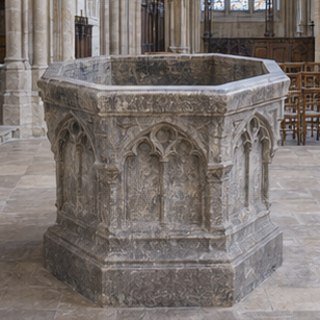
Follow the rim with your eyes. One face, then another. There are eight. For Christians, an eighth day is added, symbolically, to the seven days of the week. It is the day of the Resurrection, the beginning of a new life. You can see why this shape was so often chosen for baptismal fonts.
This font dates from the early sixteenth century. The basin was hollowed out of a single block. At the corners, the mouldings turn with fine regularity. Now look up at the painting in the chapel. You will find the water there again, and the gesture made above this font.
Finding the artwork
Near the entrance, go to the chapel that houses the large eight-sided basin.
Detail to look for
Compare the width of the opening with that of the holy-water stoup. Here, several people must be able to stand around the water.
In brief
The eight sides of the basin invite you to walk around the font and discover the meaning of baptism.
Learn more
Eight faces offer as many points of view on the same gesture around the basin. At a baptism, water is poured over the person’s head while the words of the sacrament are spoken. In the Christian tradition, the octagon can recall the “eighth day”, the day of the Resurrection. Near the entrance, this font gives concrete form to the idea of entering the community.
Octagonal basin in grey limestone, hollowed out of a single block. The mouldings run on from one face to the next. A basin proposed for the late medieval baptistery chapel. Its original installation remains uncertain. The font is the work of the workshop of Jehan Vauquelin.
- Location
- Baptistery chapel
- Artist or workshop
- Workshop of Jehan Vauquelin, stonemasons in Île-de-France
- Date
- About 1500–1530
- Material or technique
- Octagonal basin in grey limestone, hollowed out of a single block. The mouldings run on from one face to the next.
- Dimensions
- H. 102 cm · width between opposite faces 104 cm (fictitious dimensions proposed for the demo)
- History and provenance
- The font is the work of the workshop of Jehan Vauquelin. A basin proposed for the late medieval baptistery chapel. Its original installation remains uncertain.
- Sources
- La chapelle des fonts de Saint-Louis-en-l’Île, Paris · Diocèse de Paris https://dioceseparis.fr/le-baptistere-de-saint-louis-en-l.html La cuve octogonale de Notre-Dame-du-Travail, Paris · Diocèse de Paris https://dioceseparis.fr/Baptistere-de-Notre-Dame-du.html
Fictitious work of the demonstration visit of the church of Saint-Martin. The dating, materials, dimensions and interventions belong to the scenario. The sources document comparable works or practices.
 Next stop · 2 of 11The Baptism of Christ
3on the map