
The tabernacle with the Mystic Lamb
Eucharistic furniture · tabernacle door
Transcript
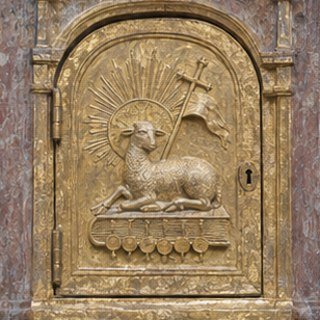
A small gilded door, a lock, and in the middle, a lamb lying on a book. Pause for a moment on this image. What could a door keep, when its decoration fits into such a small space?
It closes the tabernacle, where the consecrated hosts are kept. In the Christian tradition, the lamb represents Christ. The book it lies on, closed with seals, refers to a vision told in the Book of Revelation. The motif on the door thus echoes what the faithful come to venerate in this chapel.
In the eighteenth century, in the Paris workshop of Jean-Baptiste Ormeval, two crafts met on this small surface. The carver brought out the animal in limewood. The gilder then laid very thin sheets of gold on a prepared ground. Look for the place that shines the most. Where he burnished the leaf, the gilder turned light itself into a detail of the relief.
Finding the artwork
In the Blessed Sacrament chapel, look for the small gilded door bearing a lamb.
Detail to look for
Compare the raised parts, which give off a bright gleam, with the more matt hollows. The same gold leaf can produce both effects depending on its finish.
In brief
On a gilded limewood door, a lamb lying on a book evokes Christ and the reserved Eucharist.
Learn more
The Lamb rests on a book. The motif refers to the sealed book and the Lamb of the Apocalypse (chapter 5). It takes on a particular meaning on this small door, behind which the consecrated hosts are kept. Whereas the high altar organised the gaze on the scale of the building, here the gilder works for a close-up view.
Door in carved limewood, prepared with chalk and animal glue. The gold leaf is laid on a red clay bole, then burnished in places. A door dated to the second half of the 18th century. When it was joined to the present cabinet is not known.
Restoration chosen for the scenario: 2019 · Re-adhering of the lifting ground and retouching limited to the losses. The carved and gilded door is the work of the workshop of Jean-Baptiste Ormeval.
- Location
- Blessed Sacrament chapel
- Artist or workshop
- Workshop of Jean-Baptiste Ormeval, carver and gilder in Paris, for the door
- Date
- About 1760–1780
- Material or technique
- Door in carved limewood, prepared with chalk and animal glue. The gold leaf is laid on a red clay bole, then burnished in places.
- Dimensions
- Door alone, H. 42 × w. 30 cm (fictitious dimensions proposed for the demo)
- History and provenance
- The carved and gilded door is the work of the workshop of Jean-Baptiste Ormeval. A door dated to the second half of the 18th century. When it was joined to the present cabinet is not known. 2019 · Re-adhering of the lifting ground and retouching limited to the losses.
- Sources
- Porte de tabernacle à l’agneau sur le livre aux sept sceaux, Orschwiller · Base Palissy https://pop.culture.gouv.fr/notice/palissy/PM67001719
Fictitious work of the demonstration visit of the church of Saint-Martin. The dating, materials, dimensions and interventions belong to the scenario. The sources document comparable works or practices.