
The Virgin of Pity
Sculpture · Passion group
Transcript
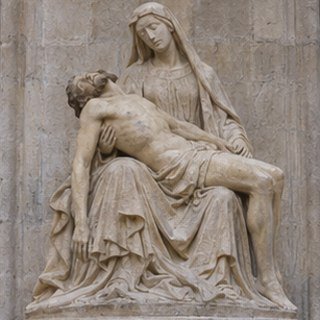
It takes a moment to understand how Mary is holding her son. Look first at her knees, then follow the outstretched body that goes beyond them on each side. One of her hands holds him close to her. The weight you sense is at the heart of this sculpture.
This image is called a Virgin of Pity. The Italian word Pietà is also used. It makes room for a moment of the Passion when gestures become rare. Jesus has been taken down from the cross. The entombment will come next. In between, the sculptor leaves us beside a seated mother.
Around the beginning of the sixteenth century, a craftsman carved the two figures in limestone. See how the folds widen at the base. All this stone under the knees gives the group its stability. Keep Mary’s hand in mind. You will find it again further on, in a very different gesture, when her son is still a child.
Finding the artwork
In the side chapel, look for a seated Virgin holding the adult Christ on her lap.
Detail to look for
Look at the hand with which Mary holds her son. Keep this gesture in mind until you reach the Virgin and Child in the Lady Chapel, number 15 on the map.
In brief
Carved from the same limestone, Mary’s mantle and the body of Christ convey the weight of the scene.
Learn more
Seated, Mary receives the adult body of her son on her lap. It spills over on both sides, while the mantle, falling to the ground, gives the group a broad base. This devotional image invites you to pause between two episodes of the Passion: the descent from the cross and the entombment. The Italian name pietà evokes compassion.
Group carved in a fine-grained limestone. The deep folds under the knees contrast with the softer modelling of the flesh. A devotional group dated to the beginning of the 16th century. Its original location remains unknown.
Restoration chosen for the scenario: 2011 · Dusting and local consolidation of a crumbling area at the bottom of the mantle.
- Location
- Side chapel · Pietà
- Artist or workshop
- Unknown sculptor
- Date
- About 1500–1525
- Material or technique
- Group carved in a fine-grained limestone. The deep folds under the knees contrast with the softer modelling of the flesh.
- Dimensions
- H. 98 × w. 108 × d. 46 cm (fictitious dimensions proposed for the demo)
- History and provenance
- A devotional group dated to the beginning of the 16th century. Its original location remains unknown. 2011 · Dusting and local consolidation of a crumbling area at the bottom of the mantle.
- Sources
- Vierge de Pitié · Musée du Louvre, département des Sculptures https://collections.louvre.fr/ark%3A/53355/cl010094496
Fictitious work of the demonstration visit of the church of Saint-Martin. The dating, materials, dimensions and interventions belong to the scenario. The sources document comparable works or practices.