
The great gallery organ
Musical instrument · gallery organ
Transcript
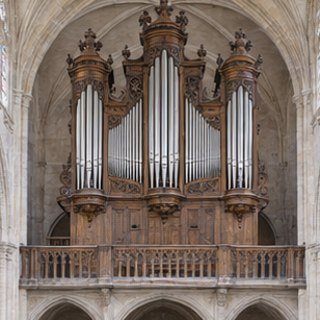
Turn round towards the entrance. The large piece of furniture up there has a rather familiar name. It is called the case. In a house, a case might hold dishes. Here, behind the oak front, whole rows of pipes are hidden.
Imagine the organist seated at the keyboards, almost invisible from the nave. He chooses a stop and puts a finger on a key. Air enters a pipe. A sound rises. With other stops, the same note can take on a different colour. And from the back pew, you will have seen only a small part of what has just happened.
What you see and what you would hear are in fact of two different ages. Around seventeen sixty, the workshop of Claude Bellavoine made the oak case. More than a century later, the organ builder Jules Marivaux reworked the instrument inside. From the nave, it is still the old oak case that gives it its face.
Finding the artwork
Go back into the nave and turn round towards the main door. The organ stands above it.
Detail to look for
Compare the age of the case with that of the instrument. The 18th-century case found a new use when the organ builder reworked the sounding part.
In brief
An 18th-century oak case houses an instrument reworked more than a century later.
Learn more
Turn round towards the door. The large piece of furniture you see from the nave is called the case. It houses several rows of pipes. From the keyboards, the organist lets air into the pipes of the stops he has chosen. A soft sound can thus accompany a single voice, then give way to a tone broad enough to carry the singing of the congregation.
Jointed oak case. Front pipes in a tin and lead alloy. Inside, some of the low pipes are made of wood. The case was kept in place during the 1882 rebuilding. Which stops were kept is not known in detail. The oak case comes from the workshop of Claude Bellavoine. Jules Marivaux rebuilt the instrument in 1882.
- Location
- Against the inner side of the façade
- Artist or workshop
- Workshop of Claude Bellavoine for the oak case; Jules Marivaux, organ builder, for the rebuilding of the instrument
- Date
- Case about 1760 · Instrument rebuilt in 1882
- Material or technique
- Jointed oak case. Front pipes in a tin and lead alloy. Inside, some of the low pipes are made of wood.
- Dimensions
- Visible case, approx. H. 6.2 × w. 5.4 m (fictitious dimensions proposed for the demo)
- History and provenance
- The oak case comes from the workshop of Claude Bellavoine. Jules Marivaux rebuilt the instrument in 1882. The case was kept in place during the 1882 rebuilding. Which stops were kept is not known in detail.
- Sources
- À Paris, Aristide Cavaillé-Coll réemploie en 1862 une partie des tuyaux de François-Henri Clicquot (1781) dans le grand orgue de Saint-Sulpice. https://www.paroissesaintsulpice.paris/la-musique-et-les-orgues/
Fictitious work of the demonstration visit of the church of Saint-Martin. The dating, materials, dimensions and interventions belong to the scenario. The sources document comparable works or practices.