
The holy-water stoup
Liturgical furniture · holy-water stoup
Transcript
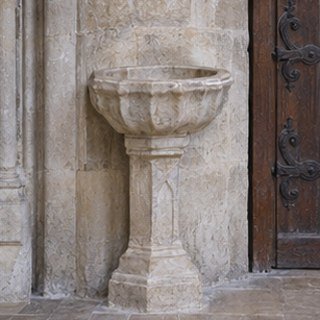
Welcome to the church of Saint-Martin. Push the door open in your mind. Your eyes get used to the half-light. You feel like looking straight up at the vaults. And yet the first object that tells the story of this church is much lower down, within reach of your fingers. It is this small stone basin.
Now imagine the stonemason at work. In a block of limestone, he hollowed out just enough to hold a little water. He rounded the rim, then set the basin on its stand. His name has been lost. The stone itself does not tell us exactly when he worked.
For generations, people have come in, dipped their fingertips in the holy water, then made the sign of the cross. This very brief gesture recalls their baptism. Keep the size of this basin in mind. In the chapel next door, another basin will tell us what happens when a whole family gathers around the water.
Finding the artwork
Once through the door, stay in the porch and look for the small basin on a stand.
Detail to look for
Follow the rim with your eyes. Its rounded profile catches a thin line of light. The wear on a surface can tell of its use, but is not enough to date the stone.
In brief
A basin at hand height keeps the memory of the sign of the cross made on entering the church.
Learn more
As soon as you step through the door, a basin meets you at hand height. Its shallow depth suits the gesture of a person dipping their fingertips before making the sign of the cross. In the Catholic tradition, holy water recalls baptism. A few steps away, the font used for baptism itself has quite different proportions.
Fine limestone, carved and then smoothed by abrasion. The basin and its stand are two separate pieces set one on the other. When it was placed in the porch, and where it first stood, remain unknown.
- Location
- In the porch
- Artist or workshop
- Unknown stonemason
- Date
- Date unknown
- Material or technique
- Fine limestone, carved and then smoothed by abrasion. The basin and its stand are two separate pieces set one on the other.
- Dimensions
- H. 95 cm · basin diameter 49 cm (fictitious dimensions proposed for the demo)
- History and provenance
- When it was placed in the porch, and where it first stood, remain unknown.
- Sources
- Un bénitier sur pied à Saint-Sulpice de Willeman · Base Palissy https://pop.culture.gouv.fr/notice/palissy/PM62006519
Fictitious work of the demonstration visit of the church of Saint-Martin. The dating, materials, dimensions and interventions belong to the scenario. The sources document comparable works or practices.